
Munich’s Oktoberfest is far more than a beer festival. Held annually on the Theresienwiese, it is the world’s largest folk festival and one of Bavaria’s most important cultural events. Combining tradition, music, regional cuisine, and centuries-old brewing heritage, Oktoberfest offers visitors a deep look into Bavarian identity—celebrated on a grand scale.
General Information
Oktoberfest takes place once a year in Munich and attracts millions of visitors from around the world.
- Location: Theresienwiese, Munich
- Duration: Mid-September to first weekend of October
- Visitors: Approx. 6–7 million annually
- Beer served: Exclusively Munich’s six traditional breweries
- Admission: Free entry to the festival grounds
The festival grounds are large but well organized, with beer tents, rides, food stalls, and traditional attractions.
A Brief History of Oktoberfest
Oktoberfest began in 1810 as a wedding celebration for Crown Prince Ludwig of Bavaria and Princess Therese of Saxony-Hildburghausen. Citizens were invited to festivities held outside the city gates on fields that later became known as Theresienwiese (“Therese’s Meadow”).
The celebration was so successful that it was repeated the following year—and gradually evolved into the annual festival known today. Over more than two centuries, Oktoberfest has grown in size while maintaining its roots in Bavarian customs and brewing tradition.
When & Where
- Season: Mid-September to early October
- Opening highlight: The ceremonial tapping of the first keg by Munich’s mayor (“O’zapft is!”)
- Festival area: Theresienwiese, southwest of Munich’s Old Town
The grounds transform into a temporary city, complete with streets, tents, and fairground attractions.
The Beer Tents
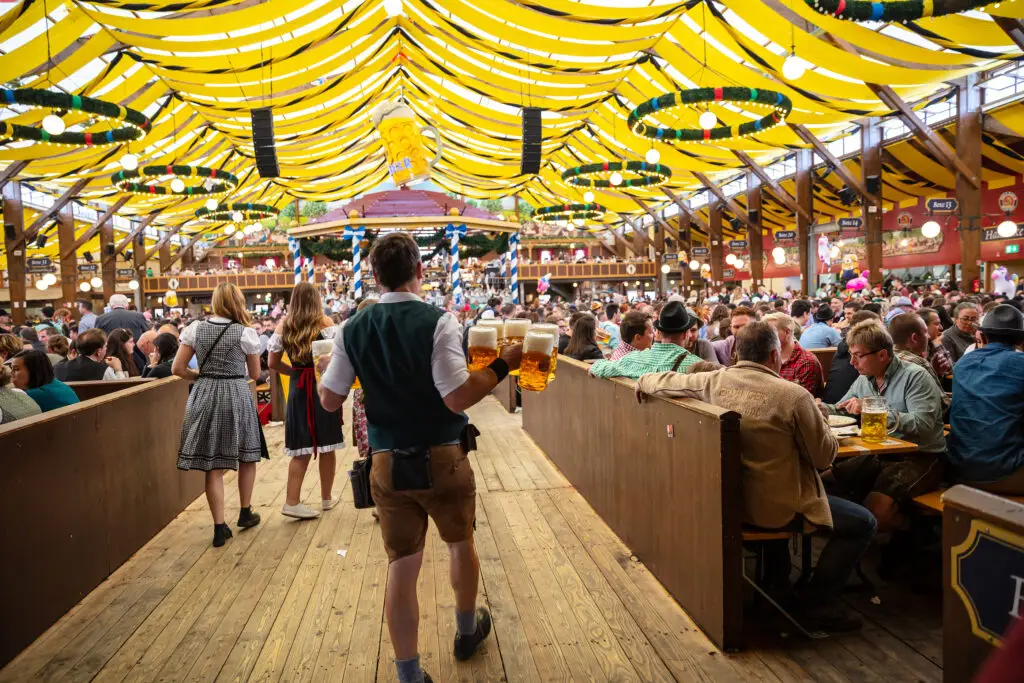
Oktoberfest features six large traditional beer tents, each operated by one of Munich’s historic breweries, along with several smaller tents.
Notable large tents include:
- Schottenhamel: Where Oktoberfest officially opens
- Augustiner-Festhalle: Known for beer served from wooden barrels
- Hacker-Festzelt: Famous for its painted “Bavarian sky” ceiling
- Hofbräu-Festzelt: Popular with international visitors
- Löwenbräu-Festzelt: Marked by a roaring lion tower
- Ochsenbraterei: Known for roasted ox specialties
Each tent offers a distinct atmosphere, music style, and menu.
What to Wear
Traditional attire is not required, but many visitors choose to wear it:
- Men: Lederhosen
- Women: Dirndls
A small cultural detail:
- Dirndl apron bow on the left indicates single
- Bow on the right indicates taken
What to Eat
Oktoberfest cuisine is hearty and designed to pair well with beer. Typical dishes include:
- Wiesn-Hendl: Roast chicken
- Schweinshaxe: Roasted pork knuckle
- Brezn: Large soft pretzels
- Käsespätzle: Bavarian-style cheese noodles
- Lebkuchenherzen: Gingerbread hearts
How to Get There
- U-Bahn: Lines U3, U4, U5, or U6 to nearby stations (Theresienwiese, Goetheplatz, Poccistraße)
- S-Bahn: Hackerbrücke station
- Walking: Approx. 20–30 minutes from the Old Town
Public transport is strongly recommended, as parking is extremely limited.
Prices & Practical Information
Payment: Cash is widely accepted; card payment varies by tent
Beer: Served in 1-liter steins (Maß), typically €14–15
Food: Main dishes approx. €15–25
Reservations: Required for large groups and evenings
Good to Know
Weather: Most tents are indoors; beer gardens depend on weather
Best time to visit: Weekday mornings or early afternoons for fewer crowds
Evenings & weekends: Very busy, lively atmosphere
Family days: Usually Tuesdays, with reduced prices on rides
Security: Bag size restrictions apply
Final Thoughts
Oktoberfest is not just a celebration—it is a living tradition that reflects Munich’s sense of community, hospitality, and pride in its brewing heritage. From ceremonial beginnings to lively evenings filled with music and shared tables, the festival brings together locals and visitors in a uniquely Bavarian way.
At VisitBavaria, we see Oktoberfest as an essential cultural experience—best enjoyed with a bit of planning, curiosity, and respect for the traditions that have shaped it for more than 200 years.