
Long before Munich became a city of beer gardens, royal palaces, and grand avenues, it was a fortified medieval town. Thick walls, watchtowers, and guarded gates controlled who could enter, trade, or pass through. Today, three historic city gates remain, quietly marking the former boundaries of the Old Town and offering a fascinating window into Munich’s past.
General Information
In the Middle Ages, Munich was protected by an inner city wall with four main gates, each aligned with an important trade route:
- Karlstor (west)
- Sendlinger Tor (south)
- Isartor (east)
- Talburgtor (Tal Gate) – later demolished
As Munich expanded in the 18th and 19th centuries, city walls became obstacles rather than protection. The Tal Gate, located near today’s Talstraße, was removed to allow for wider streets and growing traffic.
Later, a second, outer ring of fortifications was added as the city expanded. Gates from this later phase—such as the Schwabinger Tor, located near today’s Odeonsplatz and Ludwigstraße—are sometimes confused with the original medieval gates. These outer gates were dismantled even earlier, leaving no visible remains.
Today, Karlstor, Sendlinger Tor, and Isartor are the last physical witnesses of Munich’s medieval fortifications.
Karlstor (Stachus)
History
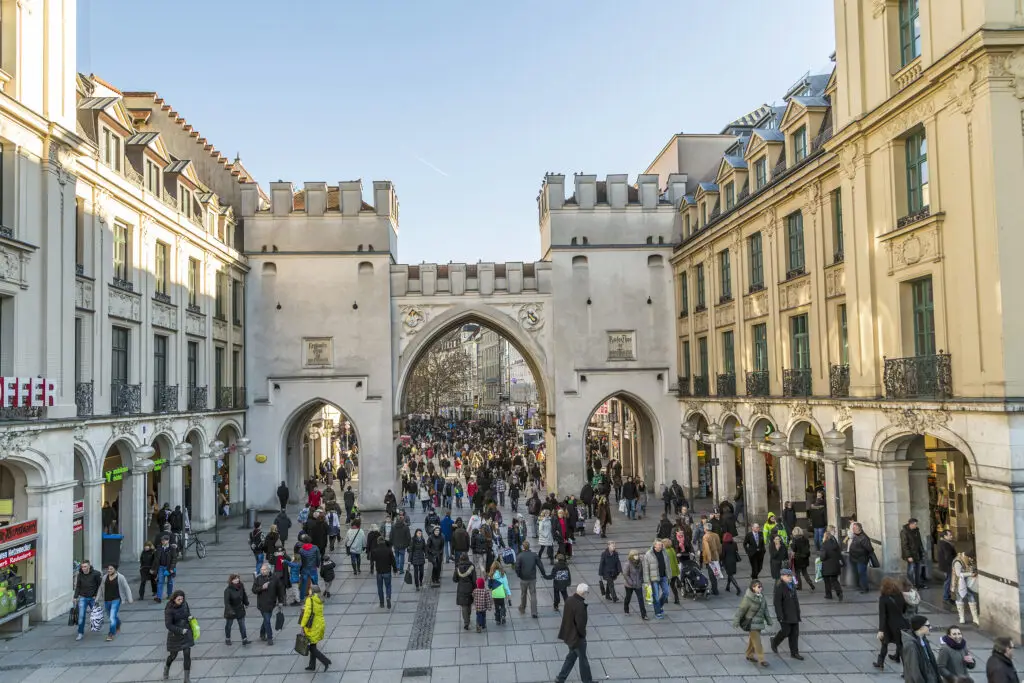
Originally known as Neuhauser Tor, Karlstor dates back to the 14th century and guarded Munich’s western entrance. Merchants traveling from Augsburg and Swabia passed through here before entering the city.
In the late 18th century, it was renamed after Elector Karl Theodor. Karlstor suffered severe damage during World War II and was rebuilt in a simplified form, preserving its twin towers.
What You’ll See Today
Karlstor frames the entrance to Neuhauser Straße, one of Germany’s busiest pedestrian shopping streets, and marks the transition from modern Munich to the historic Old Town.
Sendlinger Tor

History
Sendlinger Tor is Munich’s oldest surviving city gate, first documented in 1318. It controlled access to the important southern trade route toward the Alps and Italy.
It is also associated with the tragic Sendlinger Mordweihnacht (1705), when Bavarian farmers rebelling against Habsburg rule were brutally defeated.
What You’ll See Today
The gate stands at a lively square surrounded by trams, cafés, and everyday city life, offering a more local and less commercial atmosphere than Karlstor.
Isartor
History
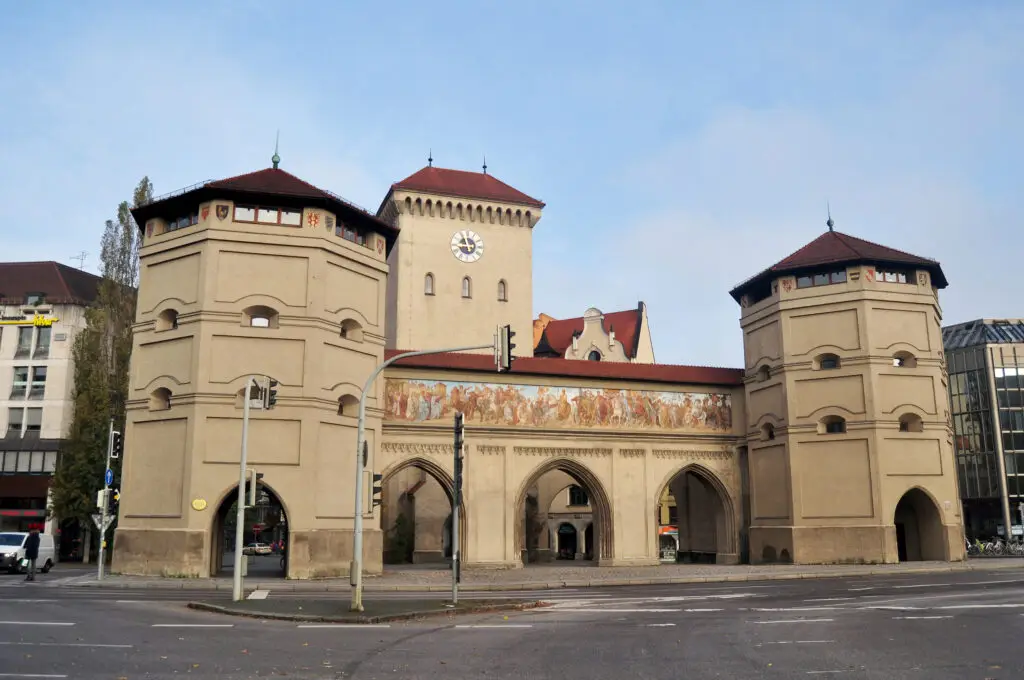
Built in 1337, Isartor is the best-preserved of Munich’s historic gates. It guarded the eastern route toward the Isar River, Salzburg, and Vienna.
A restored fresco depicting Emperor Ludwig IV’s triumphal entry into Munich still adorns the central tower—one of the few surviving medieval city murals.
What You’ll See Today
Isartor consists of a central tower flanked by two side towers. Inside is the Valentin-Karlstadt-Musäum, dedicated to two iconic Munich comedians—a uniquely Bavarian mix of history and humor.
How to Get There
- Karlstor (Stachus): U- & S-Bahn Karlsplatz (Stachus)
- Sendlinger Tor: U-Bahn Sendlinger Tor (U1, U2, U3, U6)
- Isartor: S-Bahn Isartor; tram stops nearby
All three gates are within easy walking distance and can be linked into a relaxed Old Town walk.
Prices & Visiting
- Outdoor access: Free
- Opening hours: Accessible 24/7
- Isartor tower museum: Small entrance fee (varies by exhibition)
Local Tips from VisitBavaria
- Follow the Medieval Axis: Walk from Karlstor through Neuhauser Straße to Marienplatz, continue via Sendlinger Straße to Sendlinger Tor, then head east to Isartor.
- Best Photo Times: Early morning or evening—Isartor is especially atmospheric when illuminated.
- Look for Details: At Isartor, don’t miss the fresco; at Sendlinger Tor, note subtle traces of the old city wall nearby.
- Museum Bonus: The Valentin-Karlstadt-Musäum inside Isartor is a hidden gem for culture lovers.
- Slow Down: These gates are best appreciated when you stop and imagine them as border crossings, not monuments.
Good to Know
- Fully accessible at street level
- Karlstor is the busiest; Isartor is the calmest
- All areas are well-lit and safe at night
- Easy to combine with Marienplatz, Viktualienmarkt, Asamkirche, and the Isar River
Final Thoughts
Karlstor, Sendlinger Tor, and Isartor are more than architectural remnants—they are milestones of Munich’s evolution from a fortified medieval town to an open, modern capital.
At VisitBavaria, we always say: to understand Munich, you must know where its walls once stood. These three gates are the perfect place to start.
Servus from Munich,
VisitBavaria