
Bavaria’s culinary identity is deeply tied to its landscapes—and few foods express this connection better than Bavarian cheese. From alpine meadows in the Allgäu to bustling market stalls in Munich, cheese here is not a trend or a novelty, but a centuries-old tradition rooted in agriculture, seasonality, and craftsmanship.
For travelers seeking an authentic taste of Bavaria, cheese offers a simple and satisfying way to understand the region’s culture—one bite at a time.
General Information
Cheese plays a central role in Bavarian cuisine, appearing everywhere from rural mountain huts to city beer gardens.
- Primary regions: Allgäu, Upper Bavaria, Berchtesgadener Land
- Milk types: Primarily cow’s milk; goat and sheep varieties also exist
- Traditions: Alpine pasture grazing, raw milk production, monastery influence
- Where to try it: Dairies, local markets, beer gardens, mountain huts
Many Bavarian cheeses carry protected designation or regional labeling, reflecting strict production standards.
A Brief History of Bavarian Cheesemaking
Cheesemaking in Bavaria dates back over a thousand years, shaped by monks, alpine farmers, and seasonal herders. Monasteries refined techniques, while mountain pastures provided rich grass that produced exceptionally flavorful milk.
In regions like the Allgäu, cows traditionally graze on open meadows during summer, a practice known as Almwirtschaft. This method—still widely used today—results in milk with complex aromas and high quality, forming the foundation of Bavaria’s best cheeses.
Cheese was historically a practical food: nourishing, storable, and easily transported. Over time, it evolved into a defining element of Bavarian regional identity.
Classic Bavarian Cheeses to Know
Allgäuer Emmentaler
Large holes and a nutty, slightly sweet flavor. A staple cheese, ideal for slicing or melting over dishes like Spätzle.
Obazda
A creamy, spiced cheese spread made from Camembert, butter, onions, and paprika. Commonly served in beer gardens with pretzels.
Bergkäse
A hard, aged mountain cheese with bold, nutty depth. Often compared to Alpine cheeses from neighboring regions.
Romadur
Soft, aromatic, and intense. Its strong scent contrasts with a surprisingly mild, creamy interior.
Weißlacker
A distinctive, salty specialty from the Allgäu. Strong in character and traditionally enjoyed with bread or beer.
Where to Experience Bavarian Cheese
Allgäu Cheese Route (Allgäuer Käsestraße)
A scenic network of dairies, farms, and villages offering tastings, shop visits, and insight into alpine cheesemaking.
Alpine Dairies and Mountain Huts
In regions like Berchtesgadener Land, small producers serve fresh cheese, butter, and buttermilk directly at the source.
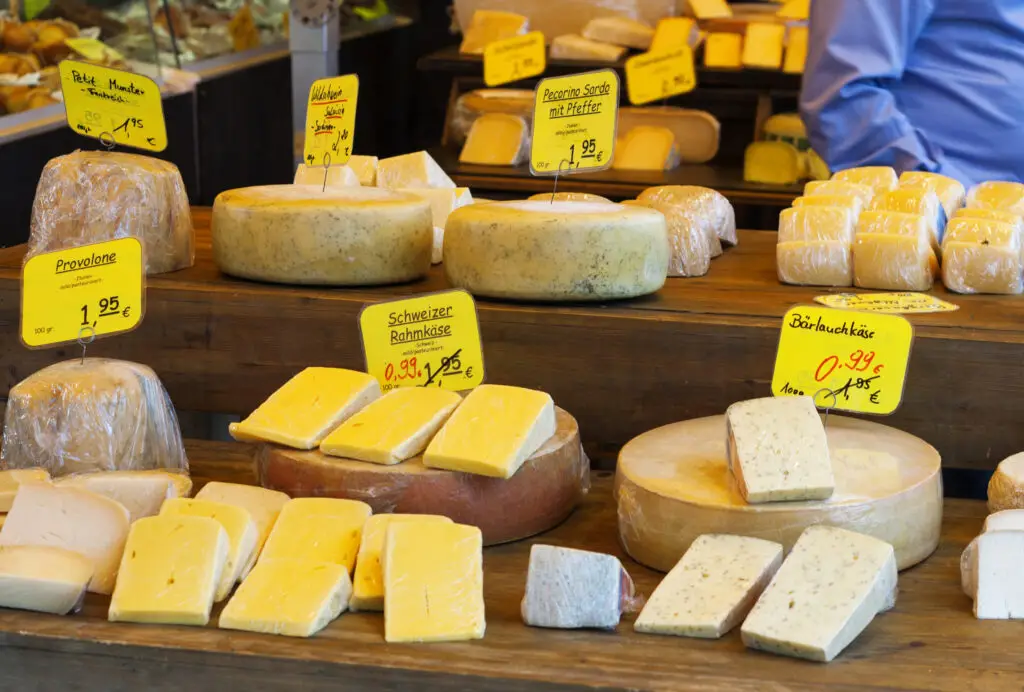
Viktualienmarkt, Munich
Munich’s central food market is an excellent place to sample a wide variety of regional cheeses without leaving the city.
Monastery Settings
Historic monasteries such as Andechs continue the tradition of pairing cheese with locally produced beer.
Practical Tips for Cheese Lovers
Slow down: Cheese culture here is about enjoyment, not rushing.
Look for “Heumilch”: Indicates traditional hay-fed milk, prized for its flavor.
Pair locally: Bavarian cheeses are designed to complement local beers.
Bring a cooler: If purchasing cheese to take home, temperature control matters.
Ask for tastings: Markets and dairies often offer samples.
Good to Know
Beer gardens: Bringing your own cheese is traditionally allowed when drinks are purchased on-site
Raw milk cheeses: Common and highly regarded
Seasonality: Summer milk often produces the most aromatic cheeses
Transport: Many cheeses travel well when properly wrapped
Final Thoughts
Bavarian cheese reflects the region itself—grounded, generous, and shaped by its natural surroundings. Whether enjoyed on a mountain pasture, at a wooden beer garden table, or from a market stall in Munich, it offers an authentic connection to Bavarian life.
At VisitBavaria, we see cheese not as a side dish, but as a cultural ambassador—quietly telling the story of alpine landscapes, rural traditions, and a way of life that values quality over haste.