
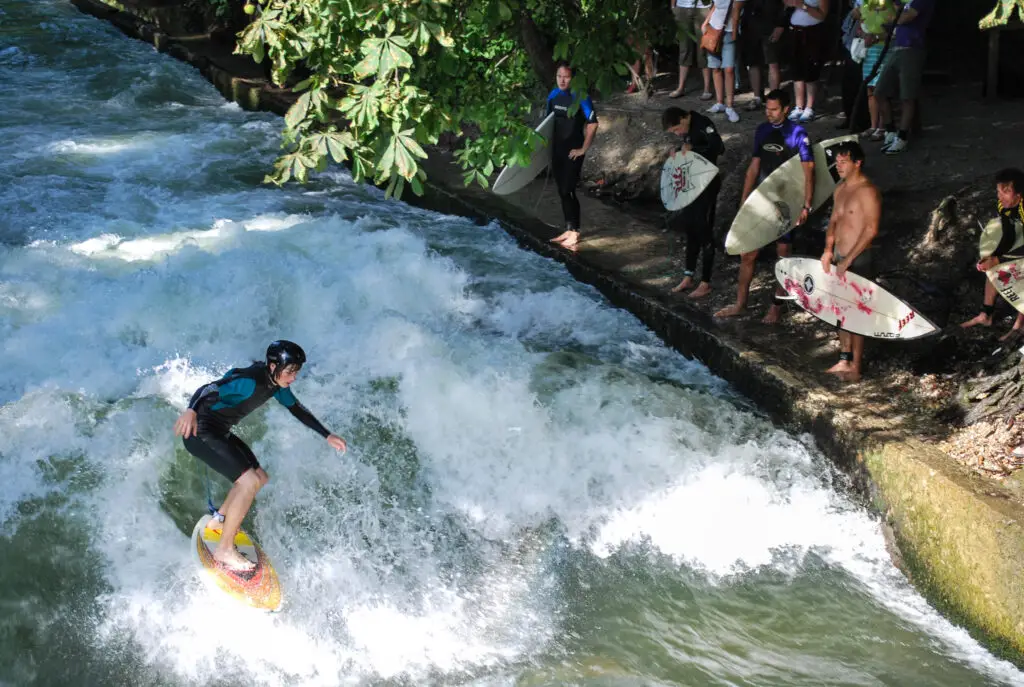
In the heart of Munich’s English Garden, just minutes from the Old Town, lies one of the city’s most surprising sights: the Eisbachwelle. For decades, surfers have ridden this powerful standing wave on a narrow river channel—year-round, in all weather—while passersby gathered along the riverbank to watch. It has long been an unmistakable symbol of Munich’s ability to blend tradition, nature, and modern urban life in unexpected ways.
At the moment, however, the Eisbachwelle is in a period of change.
Following a serious accident, the authorities have temporarily suspended surfing at the wave while safety conditions and future regulations are being reviewed. Spectators may still visit the site, but surfing itself is currently not permitted.
General Information
The Eisbachwelle is located on the Eisbach stream, at the southern edge of the English Garden, close to the Haus der Kunst.
- Location: Prinzregentenstraße / English Garden
- Access: Free, public viewing at all times
- Nearest transport: U-Bahn Lehel or Universität
- Activity status: Surfing currently suspended; viewing still possible
The wave remains clearly visible from the small bridge and the surrounding riverbank, making it easy to observe without entering the water. Tor, and Isartor are the last physical witnesses of Munich’s medieval fortifications.
What Is the Current Eisbachwelle Situation?
In early 2025, a tragic accident at the Eisbachwelle led city authorities to halt all surfing activity at the site. Since then, Munich officials, emergency services, and local surf communities have been evaluating:
- Safety standards and rescue options
- Possible technical changes to the riverbed
- Clearer rules and responsibilities for future use
As of now, there is no fixed reopening date. The goal is to ensure that if surfing returns, it does so under conditions that balance Munich’s open urban culture with modern safety expectations.n.
A Brief History of the Eisbachwelle
The Eisbach stream was engineered in the late 19th century to channel water into the English Garden and regulate flow from the Isar River. In the 1970s, local surfers began experimenting with the current, subtly shaping the riverbed to create a rideable standing wave.
For many years, Eisbach surfing existed in a legal gray area—unofficially tolerated but not formally permitted. Over time, the wave gained international recognition and became part of Munich’s identity. Its current closure marks a significant moment in that history, as the city reassesses how this tradition can safely continue. offering a more local and less commercial atmosphere than Karlstor.
Why Visit the Eisbachwelle Right Now?
A Landmark in Transition
Even without active surfing, the Eisbachwelle remains a powerful symbol of Munich’s alternative, outdoors-focused spirit.
A Place for Reflection
The quieter atmosphere offers a chance to see the wave—and the river—without crowds, and to reflect on how urban spaces evolve.
Still a Gathering Point
Walkers, cyclists, and visitors continue to pause here, keeping the Eisbachwelle part of everyday Munich life.
Nearby, cafés and paths through the English Garden still invite you to linger and enjoy the surroundings.
Best Time to Visit
- Morning: Calm, reflective atmosphere with fewer people
- Afternoons & weekends: More visitors stopping to observe and discuss the wave
While the water flows continuously, expect a noticeably calmer scene than in past years.
How to Get There
- U-Bahn: Lehel (U4/U5) or Universität (U3/U6), followed by a short walk
- On foot: 10–15 minutes from Odeonsplatz
- By bike: Easily accessible via paths through the English Garden
The Eisbachwelle remains well signposted and easy to find.
Good to Know
- Current status: Surfing prohibited until further notice
- Safety: Visitors should stay on the riverbank and off the bridge edges
- Photography: Allowed and popular—please respect others
- Nearby highlights: Haus der Kunst, Monopteros hill, Chinese Tower beer garden
Exploring Further
Those interested in Munich’s relationship with water and outdoor culture may also enjoy:
- Deutsches Museum – Engineering, hydrology, and technology
- Floßlände – Munich’s second river wave (status may also vary)
- English Garden – One of the world’s largest urban parks
Final Thoughts
The Eisbachwelle has always represented Munich at its most surprising: adventurous, informal, and deeply connected to nature—even in the city center. Its current closure marks an important pause, not an end. Like many living traditions, the Eisbachwelle is evolving.
At VisitBavaria, we see this moment as part of Munich’s ongoing story—a city that respects its culture, learns from experience, and looks carefully toward the future. Whether active or at rest, the Eisbachwelle remains a modern landmark worth visiting and understanding.